 The USD/JPY moved to a seven month high overnight as the Bank of
Japan began their two day meeting. Most analysts expect the BOJ to take
no action at this meeting, but move ahead with further easing after the
December election. The leader of the Liberal Democratic Party (LDP),
Shinzo Abe has stated he will choose someone that is more in favor on
inflation targets as the next Bank of Japan Governor if he is elected in
December. Last week, Prime Minister Noda dissolved the lower house of
the Japanese parliament and set elections for December. The lastest pols
show that Noda’s party will be defeated in the election.
The USD/JPY moved to a seven month high overnight as the Bank of
Japan began their two day meeting. Most analysts expect the BOJ to take
no action at this meeting, but move ahead with further easing after the
December election. The leader of the Liberal Democratic Party (LDP),
Shinzo Abe has stated he will choose someone that is more in favor on
inflation targets as the next Bank of Japan Governor if he is elected in
December. Last week, Prime Minister Noda dissolved the lower house of
the Japanese parliament and set elections for December. The lastest pols
show that Noda’s party will be defeated in the election.
USD/JPY reached a high of 81.58, but technical indicators show the
RSI in JPY to be near the 70 level, which is considered an overbought
situation, suggesting a reversal is in store for the currency pair. At
the present time the USD/JPY is trading in the 81.25 area. According to
the Commodity Futures Trading Commission reports, traders have
decreased their short JPY positions in the week ended November 13. The
number of contracts was 30,447 as compared with 40,104 for the week
before. The contracts report happened before Prime Minister Noda
dissolved the lower house. I would expect to see this number increase
this week.
The EURO is trading in the middle of its overnight range as finance ministers and the head of the IMF try to resolve the differences that were made public
last week regarding how the next bailout to Greece should be handled.
EU finance ministers will meet tomorrow in Brussels to continue talks
about Greece. Financing for 2013 and 2014 are expected to be concluded
at this meeting. IMF President Lagarde is expected to attend the
meeting. Traders do not expect this to go well as EUR short positions
moved to 83,646 contracts according to the CFTC, from 67,141 a week ago.
Traders seem to be focusing more on the release of news last week that
the Euro-zone economy was headed towards recession. The number of short
EUR contracts is the largest since September.
In other currencies, the USD/CAD has fallen back below the parity level, while trading in a narrow range overnight. With the Israeli-Hamas confrontation in the Middle East escalating,
the price of crude oil is rising and this is benefiting the Canadian
Dollar. Resistance for the USD/CAD appears at 1.0025 and 1.0040.
Support at .9988 is followed by .9965.
After last week’s talks, there is optimism that President Obama and
US Congressional leaders will be able to overcome differences and come
to a solution on a deal to avoid fiscal cliff at the end of the year.
FED Chairman Bernanke speaks tomorrow and traders will be listening for
any clues to further FED moves. There is concern that if the US falls
over the fiscal cliff, Chairman Bernanke will increase the liquidity
that is being added to the domestic economy to prevent a recession.
Observers remark that “Operation Twist” ends in December. This could
be continued simply by adding the amount purchased ($45 billion) to the
MBS program.
Overnight, equity markets were higher in Asia and in Europe the
markets are higher. DOW Futures are slightly positive at 5 am,
indicating a good start to the US equity market.
This is a short week for US traders and historically a rather quiet
one. I wouldn’t expect too much movement in EUR. Look for the currency
to hold the 1.27 handle. We will continue to keep an eye on the middle
east, with hopes of a peaceful settlement, sooner rather than later.
- USD: Plenty of economic news today, including
jobless claims, Markit preliminary PMI, Bloomberg consumer comfort and
University of Michigan confidence.
- GBP: MPC Minutes will (as usual) be closely scrutinised, but on this occasion unlikely to be market-moving.
Idea of the Day
The dollar has continued to climb overnight and we believe it will continue to rise in the near term. Unsurprisingly, the Eurogroup was unable to narrow its differences with the IMF despite 11 hours of discussions
– in response the euro has dropped back to 1.2750. Geo-political
tensions in the Middle East help the dollar, as does the growing sense
that America’s political leaders will do a deal to avoid a precipitous
fiscal cliff. Also, the American economy is still delivering positive
surprises. Keep the faith – stay with the greenback.
Latest FX News
- EUR: Dissecting the failure of the troika to narrow
its differences over Greece will be the major focus today, and could
well result in some further euro-selling. Ultimately, the only feasible
solution to get Greek debt back on a sustainable path is to force the
official sector to accept significant haircuts. Right now, Europe would
sooner lose its right arm than agree to this. Euro needs to fall further
to put more pressure on politicians to sort out this mess.
- USD: Very much in demand given Greece, a fragile
Japan, geo-political developments and improving American economic data.
HP accounting fraud stimulated risk-aversion, aiding the greenback.
Still looks bid against most majors. Fiscal cliff negotiations still
critical – on hold for the next week or so.
- JPY: Continues to falter, with USD/JPY reaching a 7mth high.
Tokyo will do absolutely nothing to discourage yen weakness. LDP still
pressuring the BoJ to implement ‘drastic easing’; also declares
intention to opt for massive fiscal stimulus, to increase military
personnel levels and station officials on disputed islands. On this
basis, yen weakness looks set to continue if the polls continue to
favour the LDP.
- AUD: Softened yesterday afternoon amidst
risk-aversion backdrop. That said, selling still seems remarkably
guarded. Traders seem happy to sell the yen and the euro, but less
comfortable being short Aussie.
 It has been a busy overnight ahead of the Thanksgiving day holiday in
the U.S. USD/JPY has propelled itself through the 82.00 level, while
the EUR has tumbled once again as European Union Finance Ministers failed to agree on a debt reduction package for Greece.
It has been a busy overnight ahead of the Thanksgiving day holiday in
the U.S. USD/JPY has propelled itself through the 82.00 level, while
the EUR has tumbled once again as European Union Finance Ministers failed to agree on a debt reduction package for Greece.
Let’s start in Japan. The LDP candidate Shinzo Abe made further
comments as he answered comments made by Bank of Japan governor
Shirakawa. Abe stated he wanted the government to buy bonds from the
market and wants to see inflation at the 2-3 percent level. He is also
looking to increase military spending as well as cut welfare payments by
10% and reduce corporate tax rates. Abe, who is expected to win
election on December 16, has also been advocating further easing by the
BOJ. After falling to a low of 81.70 overnight, the USD/JPY reversed
its field and has risen as high as 82.25 overnight. Technical analysts
say the currency pair could test as high as 82.70. Support at the
moment is at the 81.95 and 81.70 levels, while resistance appears at
82.40 and 82.65.
The EUR fell below the 1.2800 level finally settling at 1.2735 after
Eurozone finance ministers failed to agree on a debt-reduction package
for Greece. There was also no approval of the next tranche of bailouts,
which has been on hold since June. The meetings lasted almost 12 hours
as a key issue remains the IMF’s reluctance to give Greece an extra two
years to reach their deficit target. The IMF wants this target reached
by 2020, while the Finance Ministers are willing to wait until 2022.
The EUR has come back a bit as German Chancellor Merkel has made
various comments as to how to come to a compromise, but the selling
pressure remains. Analysts are now looking at a longer term target of
1.2660, if there is no deal in the near future. Suffice to say, an
agreement would see the EUR move back towards the 1.2820 level. As for
that aid payment to Greece that has been on hold since June, the next
meeting for the finance ministers is November 26, so it will be held at
least until then. The ebb and flow of the EUR is certain to be
influenced by Euro finance minister comments as well as comments from
European leaders.
The British Pound moved higher after the release of Bank of England
minutes showed the MPC voted 9-0 to keep rates at 0.5% and 8-1 to keep
the QE target at GBP 375 billion. GBP rallied to 1.5930 before settling
back into the “1.59 teens”.
Fed Chairman Ben Bernanke spoke at the New York Economic Club
yesterday and said that “accumulating evidence does appear consistent
with the financial crisis and the associated recession having reduced
the potential growth rate of our economy somewhat during the past few
years”. In other words, we are not growing as an economy as fast as he
would have liked. He also said the Fed lacks measures to alleviate the
impacts of the fiscal cliff. He warned that “Congress and the
administration will need to protect the economy from the full brunt of
the severe fiscal tightening at the beginning of next year” as the
fiscal cliff would “pose a substantial threat to the recovery” and “a
fiscal shock of that size would send the economy toppling back into
recession”. These comments were not taken kindly by the equity markets
and his remarks made the DOW tumble. As far the economic outlook was
concerned, Chairman Bernanke remained cautious over employment and the
housing market. He stated that “the unemployment rate is still well
above both its level prior to the onset of the recession and the level
that my colleagues and I think can be sustained once a full recovery has
been achieved”.
Once again liquidity is expected to be a concern as traders look for an early release ahead of the Thanksgiving holiday.
Expect the ranges to remain intact today, with downward pressure on the EUR to remain.
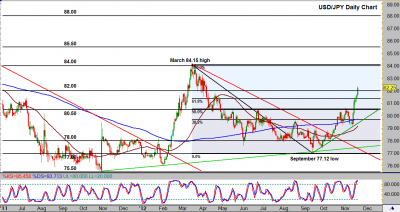
USD/JPY (daily chart) has extended its week of significant gains,
establishing a new 7-month high in the process. During this substantial
upside run, price has broken out above several important resistance
levels, including the key 80.50 level, which the pair had previously
been unable to breach for the prior 6 months. USD/JPY has just risen to
break out tentatively above 82.00 and, bearish retracements
notwithstanding, has a potential upside bias towards a re-test of the
important 84.00 level, last hit in mid-March. For the past two months,
price has been forming a bullish trend line extending back to the
September low around 77.00. The current bullish breakout run can be seen
as an acceleration of that short-term uptrend. To the downside, the
strong previous resistance level at 80.50 could potentially serve as new
support for any near-term bearish corrections.
Forex trading involves a substantial risk of loss and is not suitable for all investors. FX
Solutions LLC (“FXS”) is compensated through a portion of the bid/ask
spread. This information is being provided only for general market
commentary (based on technical analysis) and does not constitute
investment trading advice. Certain information contained herein has
been obtained from sources that FXS believes to be reliable; however,
FXS cannot guarantee the accuracy of such information, assure its
completeness, or warrant such information will not be changed. The
information contained herein is subject to change without notice. FXS
has no obligation to update any or all of such information; nor do we
make any express or implied warranties or representations as to the
completeness or accuracy or accept responsibility for errors. These
materials are not intended as an offer or solicitation with respect to
the purchase or sale of any financial instrument and should not be used
as the basis for any investment decision. Past performance is not
necessarily indicative of future results. No determination has been made
regarding the appropriateness of any information contained herein. Due
to various risks and uncertainties, actual events or results may differ
materially from those reflected or contemplated herein. FXS expressly
disclaims any loss or profits that may arise from any use of the
information contained in or derived from this commentary. FXS and its
affiliates may engage in transactions that are inconsistent with the
views expressed herein. FXS does not endorse nor is it responsible for
any third-party posts related to this material.
Markit’s purchasing managers’ indices improved in the euro-zone, but
all the forward looking figures remain under the critical 50 point mark –
contraction.
With calm on the Greek front (for now), EUR/USD remains stable in the higher range: at 1.2864, capped by resistance at 1.2880.
 The all-European Services PMI rose from 45.4 to 46.2 points,
exceeding expectations of 45.6. Services PMI actually dropped from 46 to
45.7 points, below expectations of ticking up to 46.1 points.
The all-European Services PMI rose from 45.4 to 46.2 points,
exceeding expectations of 45.6. Services PMI actually dropped from 46 to
45.7 points, below expectations of ticking up to 46.1 points.
In France, Markit reported another month of improvement, but the
figures are still deep in contraction territory: manufacturing PMI rose
from 43.7 to 44.7, beating expectations of a rise to 44.1 points.
Services PMI also came out better than expected, with a score of 46.1
instead of 45.3 expected, and 44.6 in the previous month.
In Germany, manufacturing recovered, rising from 46 to 46.8, beating
expectations of a slide to 45.9. However, the services sector, which
flirted with 50 points, continues to slide: 48 points, lower than 48.5
that was expected and 48.4 last month.
EUR/USD
was slightly higher as the pair was helped by positive PMI data out of
France, Germany and the Euro-zone. French and German Flash Manufacturing
PMIs led the way with readings better than the estimate. A meeting
between the Euro-zone finance ministers and the IMF failed to reach an
agreement on Greece, but Chancellor Angela Merkel said that it was
possible that a solution could be found when the two sides meet
again early next week. In the US, the markets are closed today for the
Thanksgiving holiday.
EUR/USD Technical
- Asian session: Euro/dollar edged downwards, consolidating at around 1.2850. The pair is steady in the European session.
- Current range: 1.28 to 1.2880.
Further levels in both directions: 
- Below: 1.28, 1.2750, 1.2690, 1.2624, 1.2590, 1.25, 1.2440, 1.2390, 1.2250, 1.2140 and 1.2042.
- Above: 1.2880, 1.2960, 1.30, 1.3030, 1.3080, 1.3140, and 1.3170.
- 1.28 has strengthened in support as the pair improves.
- 1.2880 is the next line on the upside, providing weak resistance.
Euro/dollar higher on positive European PMIs– click on the graph to enlarge.
EUR/USD Fundamentals
- 8:00 French Flash Manufacturing PMI. Exp. 44.1 points. Actual 44.7 points.
- 8:00 French Flash Services PMI. Exp. 45.3 points. Actual 46.1 points.
- 8:30 German Flash Manufacturing PMI. Exp. 45.9 points. Actual 46.8 points.
- 8:30 German Flash Services PMI. Exp. 48.5 points. Actual 48.0 points.
- 9:00 Euro-zone Flash Manufacturing PMI. Exp. 45.6 points. Actual 46.2 points.
- 9:00 Euro-zone Flash Services PMI. Exp. 46.1 points. Actual 45.7 points.
- Day 1: EU Economic Summit.
- 9:46 Spanish 10-year Bond Auction. Actual 5.52%.
- 15:00 Euro-zone Consumer Confidence. Exp. -26 points.
EUR/USD Sentiment
- Positive European PMIs bolster euro: The
markets cheered as PMI data from France, Germany and the Euro-zone was
mostly positive. Manufacturing PMI data from all three
locations exceeded their respective estimates. The strong figures are
certainly a welcome development and have helped boost the euro,
which has been under a lot of pressure lately.
- Cease fire announced in Israel, Gaza: After a week
of heavy fighting, a ceasefire was finally reached between Hamas and
Israel late on Wednesday. The violence flared right up to the ceasefire
deadline, and there is deep skepticism whether the fragile truce will
hold. If the situation stabilizes, Egypt will act as an intermediary for
further discussions between Hamas and Israel, such as reopening the
crossings between Gaza and Israel.
- Greek saga continues as Eurogroup, IMF deadlocked: The
Euro-zone finance ministers and the IMF huddled in Brussels on Tuesday
for over 12 hours, but the marathon talks failed to produce a
breakthrough over what action to take on the Greek debt crisis. The
Euro-zone finance ministers wish to Greece a two-year extension, till
2022, to slash its debt to 120 percent of GDP. Currently, the debt to
GDP ratio stands at 176 per cent. The IMF is against the extension,
preferring to see EZ member states write off some of Greece’s debt.
Without some agreement, the troika cannot give Greece the next tranche
of aid, which amounts to some 44 billion euros. The parties will meet
again on Monday, and Chancellor Merkel sounded cautiously optimistic
that an agreement can be reached. However, even if a deal is reached,
it will still have to be approved by the parliaments in several
countries. For its part, Greece continues to implement reforms demanded
by the troika. These include an overhaul of the tax system, the creation
of a committee to supervise budget execution and further
privatizations.
- Moody’s downgrades France: The Moody’s credit
agency downgraded France from its AAA rating to AA1. The agency followed
up with a tough assessment, warning that France’s economic outlook
remains “negative”, and that it had doubts that the Hollande government
could implement necessary structural reforms and spending cuts. Moody’s
also noted that the French economy was at risk due to other struggling
Euro-zone members. The downgrade followed a scathing report in the
prestigious Economist magazine about the perilous state of the France’s
economy, entitled “The time bomb at the heart of Europe”. The French
government is fuming over the downgrade and unflattering magazine
article, which may well cause investors and companies to think twice
before doing business with France.
- Markets positive over fiscal cliff co-operation: The
markets were pleased with a recent meeting between congressional
leaders and President Obama as Republican and Democrats sounded upbeat
about reaching an agreement over the looming fiscal cliff crisis.
Politicians on both sides are seeking to reassure nervous taxpayers and
investors that they will take fast and decisive action to avoid massive
tax hikes set to occur in January. However, Republicans and Democrats
are far apart on how best to reduce the staggering US debt, and reaching
a compromise promises to be a difficult task.
- Catalan election could lead to calls for independence: With
the markets focused on Greece, and Madrid managing without a bailout
for now, Spain has not been on the front pages lately. That could change
next week, a the region of Catalonia
holds elections on November 25. The independence movement is enjoying
growing support, as many Catalans are unhappy about propping up other
regions while they are forced to make cuts and ask the central
government for aid. However, the central government has balked at
giving Catalonia more of a say in its finances, which has only served to
fan the separatist flames. If the pro-independence parties win the
upcoming election, we could see more unrest, which is the last thing the
country needs as it struggles with severe economic problems.